 Shopping Cart (



A curved staircase immediately captures the attention of anyone who steps in, changing your home’s appeal and feel. A modern, curved staircase signals intent, softens modern interiors by eliminating hard lines, and fully guides movement with a flow that contrasts with the rigidity of straight runs.
The current curved staircase design trends focus on clear geometry, in-depth detailing, and a high contrast between the materials to define the structural architecture.
If you want to highlight your vertical space and connect levels without visual breaks, this quick guide will explore some of the top curved staircase ideas, offering elegance without visual noise.
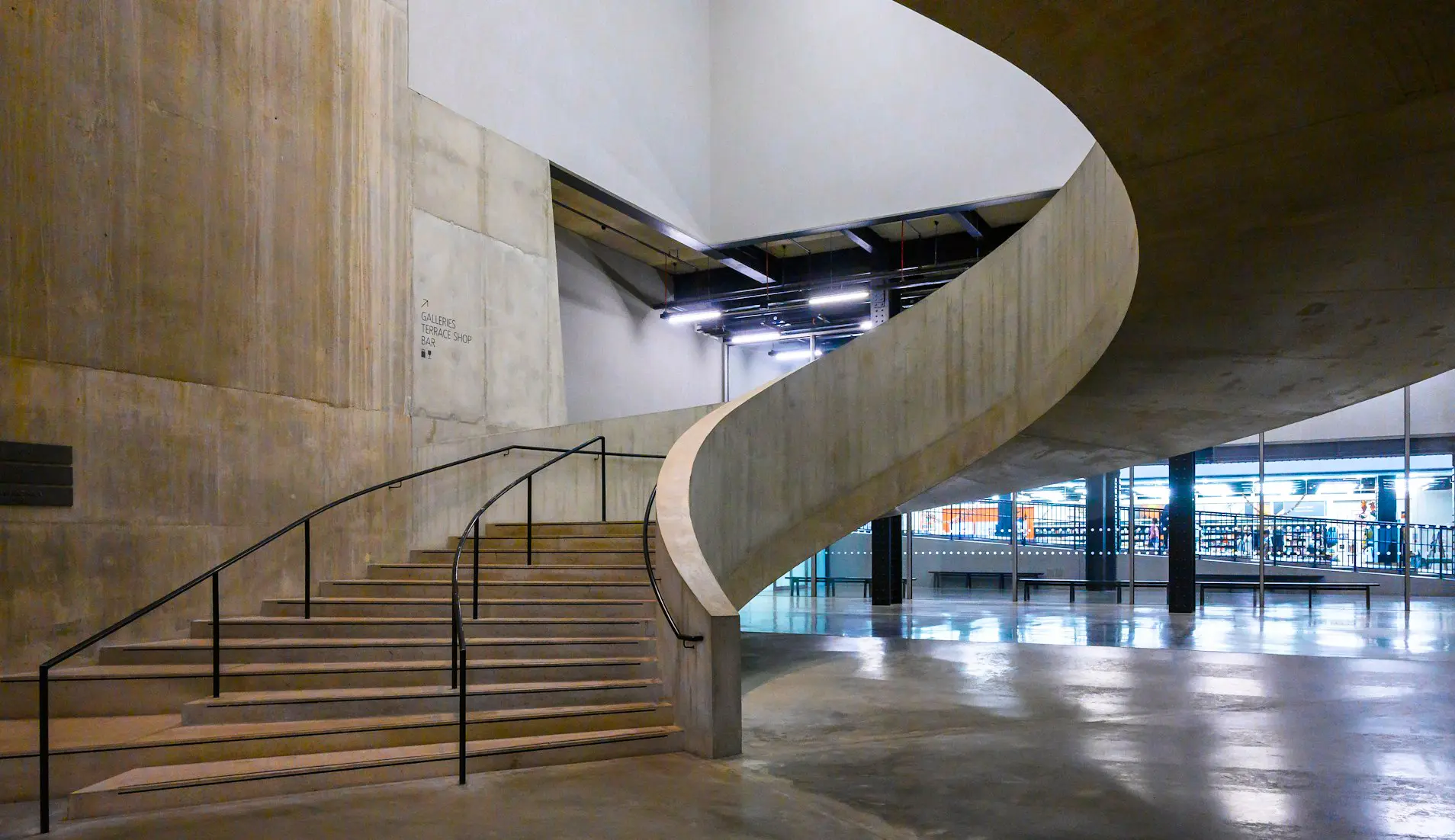
Key Features of Curved Handrails for Stairs
The features of a curved handrail for stairs work together to determine how the staircase feels to the touch, its visual appearance, and its performance over time. To understand how all features blend together, let’s go through the most important:
Precision Geometry
The curved handrail goes along the line of the staircase without any transition points, edges, or breaks along the way. The continuity of the material is what makes the clear lines and guides the hand through the entire length, from start to end.
In most open layouts, the curved stair handrail is the structural piece that underlines the integrity of your staircase and reinforces the visual flow.
Structural Integrity
With most modern hand railing materials, the highest level of engineering can be found within the core and joints to support long-term stability. It does not matter whether the railing is made from glass or wood; a properly crafted curved railing should always deliver superior strength.
Therefore, the slim profiles could be misleading the eye about the integrated balance, improving not only the looks but also bringing incredible strength.
Material Compatibility
A high-quality bending handrail may easily adapt to different layouts, finishes, and architectures without potential distortion. That’s why designers often go with wood handrails or even stainless steel options to visually match the surrounding stair parts.
Hence, based on the specific architectural design, a flexible material eases the installation and adapts to custom layouts for seamless integration.
Visual Integration
A curved banister frames the stairs rather than overpowering them. When aligned with the tread radius, a curved banister rail enhances depth and shadow lines. This detail elevates both safety and overall stair design without added ornament.
Curved Stair Railing Materials - Glass, Metal & Timber Options
The material selection is perhaps the most important decision when it comes to the curved stair railing, as well as your overall staircase design. So, each option offers different strengths and covers distinct spatial goals within your architectural design.
Let’s go over the most popular – glass, metal, and timber options!
Curved Glass Railings
Curved glass stair railing is ideal for open interiors where light matters, and the transparency of the glass can determine the entire mood and vibe.
- Transparency & Flow: Glass matches perfectly when you want to allow sunlight that will underline the connection between your floors and feel natural.
- Precision Curvature: The lack of flexibility with glass requires heat-formed panels that are crafted precisely as per your stair radius, making them a bit more expensive.
- Minimal Visual Weight: The glass can provide ultimate protection without creating a visual mess and momentarily capture attention as soon as you walk in.
Quick Fact: The laminated safety glass will remain intact even when cracked.
Curved Metal Railings
The metal option would be ideal for contemporary environments where structural detail is really important, especially when making your stairs curved.
- Base Consistency: The metal options provide ultimate longevity without any flexing or bending under pressure, making it ideal for the entire length run.
- Material Longevity: The metal material itself resists moisture and impact, which also makes it perfect for areas with high traffic and daily pressure.
- Installation Efficiency: Metal can easily integrate with modular systems and kits made for easy installation and very secure anchoring.
Quick Fact: Curved aluminum stair railing and steel railings require minimal upkeep!
Curved Timber Railings
Timber and Red Oak (the most preferred wood species) are the most popular and cost-effective choice for curved stair railing, bringing warmth and comfort in pretty much any home.
- Natural Adaptability: Timber supports absolutely any curved layout, shaped through lamination and advanced forming techniques to bring perfect curves.
- Finish Versatility: The finish options are endless, accepting oils, stains, and sealants to pretty much match absolutely any home environment design.
- Material Character: Wood introduces a lot of variations with depth and visual interest, which can completely transform your staircase without overwhelming the space.
Quick Fact: Laminated hardwood handrails will maintain their shape better than solid timber!
Where Curved Stairs Work Best
Curved staircases work ideally where the spaces are tight, but freedom of movement remains a priority. The curved stair layouts are an architectural peak, and here’s where they work the best:
| Location: | Why it Works: |
| Home Entry Halls | A curved staircase design creates an immediate focal point and sets spatial hierarchy from the first step. |
| Open Living Areas | Curved stair layouts improve circulation and keep sight lines open across shared zones. |
| Vertical Void Home | A curved stairwell fills tall spaces without breaking visual continuity between floors. |
| Rounded Geometry Areas | Curved steps align naturally with radial layouts and reduce visual tension near walls. |
| Feature Interiors | Curved staircase ideas suit homes where form and movement define the interior concept. |
Note: All curved layouts require much more planning space than straight runs!
Types of Curved Staircases
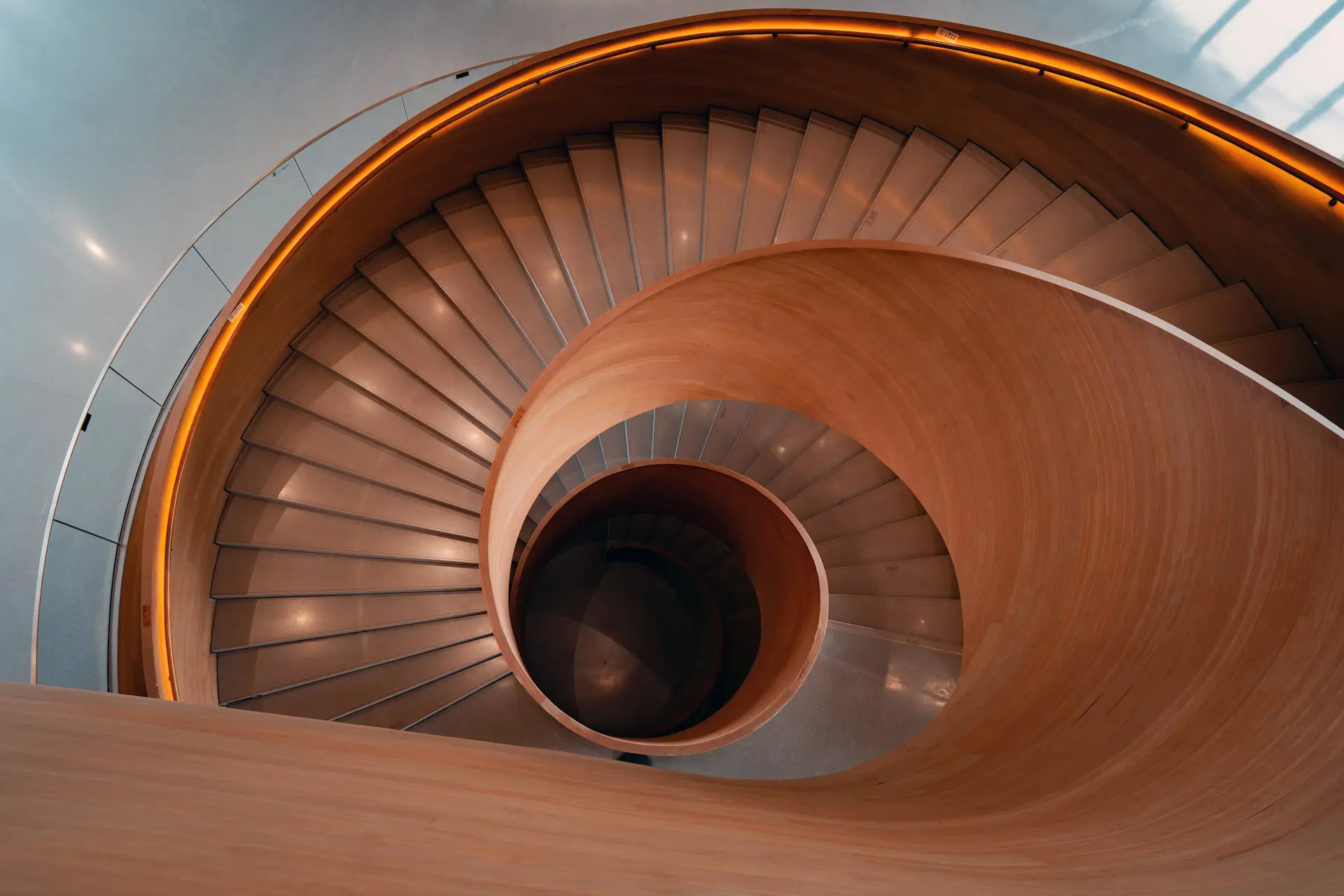
When it comes to curved staircases, you’ve probably already seen that there is more than one way (type) to achieve curvature with your layout.
However, the choice strictly depends on your space and geometry!
Spiral Staircase
The traditional spiral staircase is what everyone imagines when speaking about curved stairs. This is a staircase that goes around the central axis, making it ideal for interiors where space is vastly limited. In short, this is a railing system that loves tight spaces – the most compact option.
Helical Stairs
The helical stairs use a completely different approach; they curve without a central column, which opens up a wider area for movement and a fluid walking path. This design is much better suited to more open areas, where you want the structural design to be visually exposed for aesthetics.
Double Curved
The double curved staircase splits or mirrors its curve, often forming a symmetrical statement in large entry spaces. This is one of the most visually appealing designs, crafted around balance and visibility, forming a strong and reliable circulation route.
Along the Wall
Another type of curved stairway may follow a curved wall, blending into the home’s architecture rather than being a standalone feature. This option is only possible when there is a curved wall to follow, but when you have the opportunity for it, custom curved layouts are always preferred.
Angled Transitions
There are a lot of curved stair designs that can blend the radius sections with short and straight, or even angled stair segments. You would see such designs when the floor is uneven or irregular, which is a very specific custom design supporting movement between floor levels.
Factors to Consider When Designing a Modern Curved Staircase
Before planning anything, you must first understand how to build a curved staircase; therefore, knowing each factor to consider – structure, movement, and safety. This is important because every choice directly affects how the curved railings perform visually and structurally over time.
Let’s go through the standout importance of curved stair railings:
- Spatial Planning: First, you must determine an adequate clearance that supports the movement and prevents any tight areas with curved stairs.
- Railing Integration: You need to determine the type of your curved staircase banister, since it must perfectly align with the tread geometry.
- Safety Compliance: There are local building codes (spacing and height) for your hand railings and banisters, which guarantee security.
- Structural Support: You need to determine the best material as per your layout and load distribution to guarantee balance across your stair railing system.
- Material Coordination: In many cases, a combination of materials may be the best choice to provide smooth finishes, visual appeal, and safety.
As you’re confident with your planning, we recommend exploring what curved handrail kits have to offer and how they can be implemented on your curved stairs. With some adequate planning, you can easily transform curving stairs into an architectural home feature with visual balance.