 Shopping Cart (



Closet Rod Support - Metal Closet Rod Brackets & Closet Pole Holders
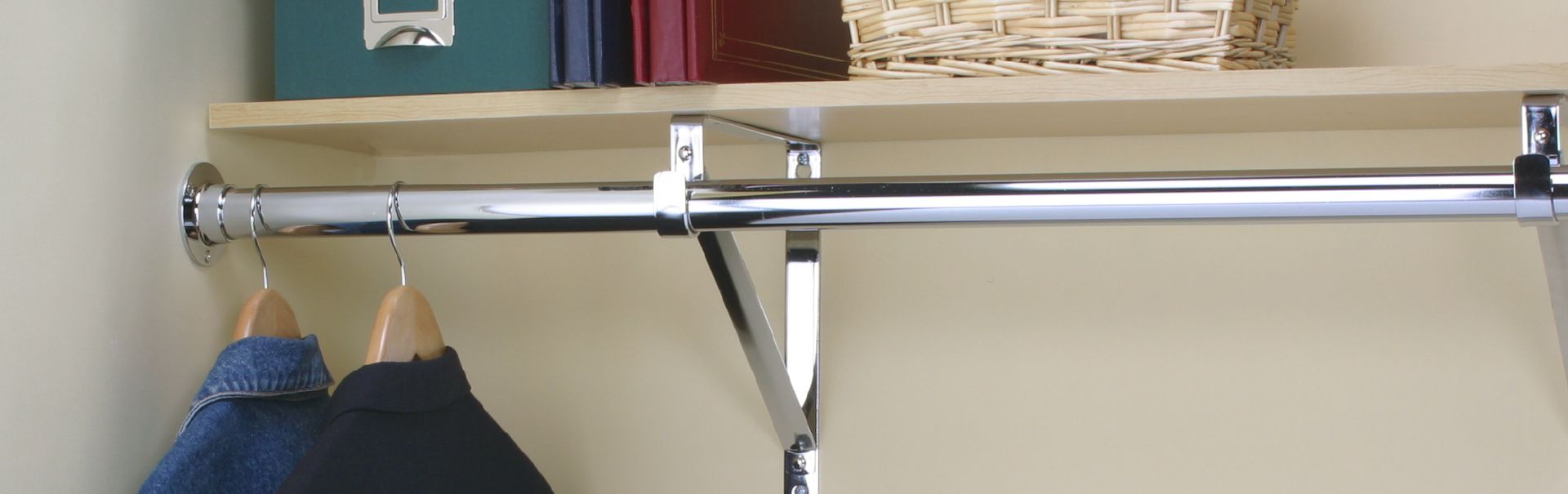
Closet Rod Support Brackets & Heavy Duty Holds
Prevent closet system failure and unsightly sagging with closet rod support brackets engineered for heavy-use storage environments. While a standard closet setup focuses on style, its long-term durability depends entirely on its closet pole holders and necessary center supports.
At BuyRailings, we supply professional-grade metal hardware, including heavy-duty closet rod support brackets, adjustable intermediate holds, and end flanges, required to build a sturdy closet that can support hundreds of pounds of clothing without bending.
Our components are crafted from premium metals with durable, plated finishes like oil-rubbed bronze, brushed brass, polished chrome, satin stainless, and clean white to match your custom aesthetic.
The Sagging Rule: When Does a Closet Rod Need Support?
A major frustration for homeowners is asking: How long can a closet rod be without support?
To maintain structural integrity and a clean horizontal profile, you must understand the limitations of standard closet rod hardware based on the material's structural load capacity.
The 5-Foot Rule for Metal Closet Rods
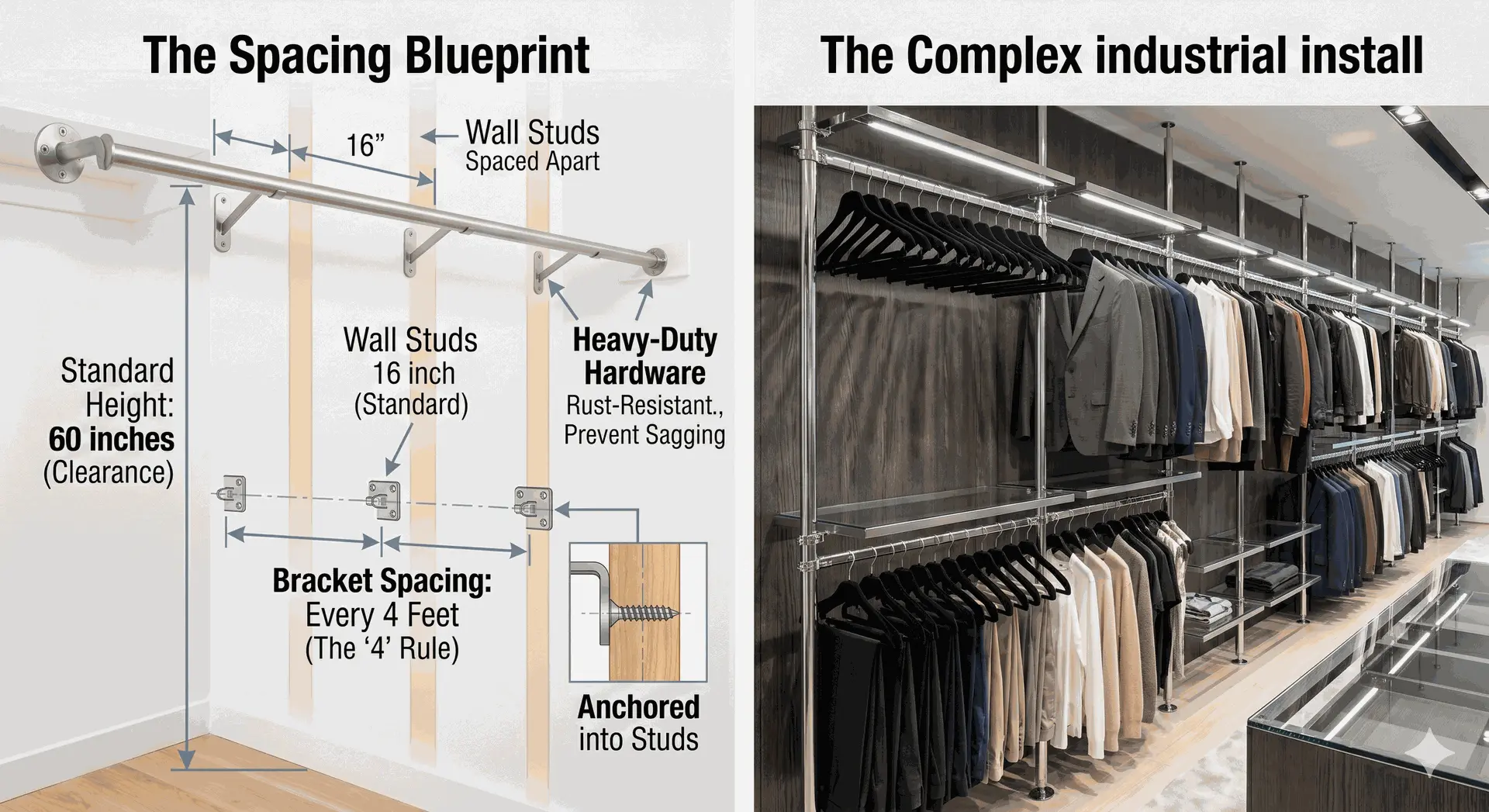
For a standard 1 - 1.5" steel or aluminum closet rod metal run, you cannot exceed 5 feet (60 inches) without installing an intermediate support. A 6-ft closet rod carrying a standard load of winter coats will inevitably sag, leading to failure.
If your layout spans beyond 5 feet, for example, when installing an 8ft closet rod or a massive 10ft closet rod, you are legally and structurally required to install a continuous center support for closet rod stability. This rule ensures the system can bear the concentrated load of standard apparel without structural failure.
Strategic Component Integration for Custom Closets
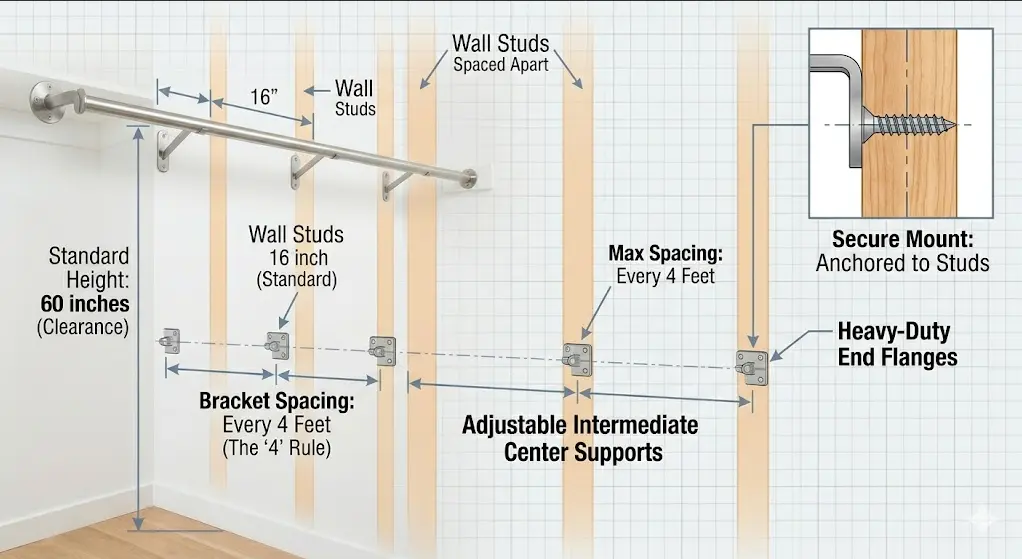
Building a stable closet system requires integrating different support hardware based on your wall substrate (hitting studs) and total load requirements:
- Closet Rod Center Support Bracket: For long runs, an adjustable intermediate holder is necessary to support the rod at its midpoint and prevent deflection.
- Closet Rod Support Hook: Utilized when anchoring directly into a wooden shelf above the rod, this hook allows the rod to pass through while sharing the load with the shelving unit.
- Adjustable Closet Rod Support Bracket: For custom or sloped environments, these adjustable closet rod center support anchors let you fine-tune the rod's horizontal alignment.
- Closet Rod Support Pole: Used primarily in open-concept commercial racking or walk-in closets, this structural pole transfers the load directly from the rod down to the floor, bypassing the wall structure entirely.
Frequently Asked Questions (FAQ)
What are common handrail installation mistakes?
The most severe mistakes include setting the handrail height outside the required $34$-to-$38\text{ inch}$ range, spacing support brackets too far apart (violating the 4-foot rule), and anchoring brackets into hollow drywall instead of drilling directly into solid vertical wall studs.
How do you make a closet rod support sturdy?
A sturdy closet rod installation relies entirely on weight distribution and anchoring. First, utilize heavy-duty closet rod support brackets rather than cheap plastic holds. Second, ensure every bracket is anchored directly into a vertical wall stud using structural closet rod hook fasteners. Third, always adhere to the 5-foot rule by adding an additional support bracket at the center point for any run longer than 60 inches.
How to support a closet rod in the center without blocking hangers?
For center support, use a specialized closet rod, a middle support loop, or a bypass bracket. These designs support the rod from the top or back, allowing standard hangers to slide smoothly past the support connection without snagging, maintaining 100% usability of the long hang space.