 Shopping Cart (



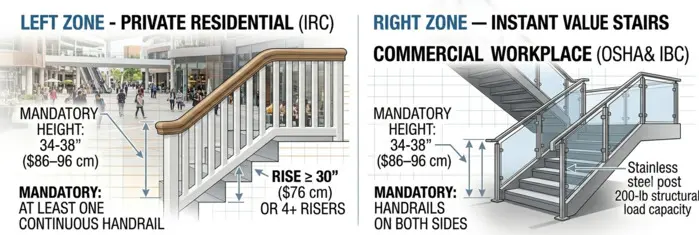
- The Height Rule: A handrail is universally required on any stairway with a total vertical rise of 30 inches (76 cm) or greater above the floor or grade level.
- The Step Rule: This height trigger typically equates to 4 or more risers (steps).
- Single-Family Homes (IRC): Requires at least one continuous handrail on stairways with 4 or more risers.
- Commercial & Workplace Buildings (OSHA & IBC): Require handrails on both sides of all stairways, plus structural guardrails on open sides if the fall hazard exceeds 30 inches.
Sourcing code-compliant components? BuyRailings manufactures heavy-duty Handrail Brackets and Pre-Cut Stainless Steel Tubing engineered to withstand the 200-pound structural load requirements mandated by safety inspectors.
Decoding Building Codes: IBC, IRC, and OSHA Standards
When determining code compliance for structural stairs, guessing will result in failed structural inspections and immediate safety liabilities. You must separate residential standards from commercial workplaces.
1. Residential Homes (International Residential Code - IRC)
Under the IRC, safety requirements target standard single-family homes:
- When Required: Handrails must be provided on all stairways with four or more risers.
- Step Calculations: If a stairway has 3 steps (3 risers), a handrail is structurally optional unless the total vertical rise exceeds 30 inches. If a stairway has 6 steps, a handrail is mandatory.
- Which Side? The handrail only needs to be installed on one side of the staircase, allowing the opposite side to feature an open face or a plain wall.
2. Commercial Buildings (International Building Code - IBC)
Commercial codes govern retail spaces, multi-family complexes, and public infrastructure:
- Continuous Dual Support: Handrails are strictly required on both sides of all stairways to ensure accessibility.
- Clear Clearance: The handrail must maintain a minimum clear space of 1.5 inches between the wall substrate and the handrail tubing to prevent hand-trapping during an emergency exit.
3. Industrial Workplaces (OSHA Standards)
The Occupational Safety and Health Administration governs employee safety zones, factories, and warehouses:
- The OSHA Trigger Rule: Handrails must be provided on all stairways with four or more risers or a rise greater than 30 inches.
- Structural Load Minimums: The complete top rail, wall brackets, and handrail assembly must be mathematically engineered to withstand a concentrated, lateral weight load of at least 200 pounds (91kg) applied in any downward or outward direction.
Sizing & Dimensional Code Constraints
| Code Metric | Residential (IRC) Requirements | Commercial/Workplace (IBC/OSHA) |
| Mandatory Height | 34 to 38 inches from step nosing | 30 to 37 inches (OSHA) / 34 to 38 inches (IBC) |
| Required Sides | Minimum of one side | Both sides mandatory |
| Maximum Run Span | 12 feet vertically before a landing | 12 feet vertically before a landing |
| Baluster Spacing | Openings must block a 4-inch sphere | Openings must block a 19-inch space (OSHA) |
How many steps require a handrail?
Nationally recognized IRC and OSHA building codes dictate that a handrail is required on any interior or exterior stairway featuring four or more risers (steps). For stairways with fewer than four steps, a handrail is still required if the total vertical rise of the stairs reaches or exceeds 30 inches.
Are handrails required on both sides of stairs?
In commercial facilities and public buildings regulated by the IBC and OSHA, handrails are mandatory on both sides of the stairs. In private residential homes regulated by the IRC, a handrail is only required on one side of the stairway, provided any open, unprotected sides feature a guardrail to block falls.
Step-by-Step Installation: Attaching a Handrail to a Wall
Before anchoring structural brackets to your wall studs, ensure your wall base trim handles the layout pitch.
If you are retrofitting or building from scratch, check out our guide to sizing and cutting a custom stair skirt board to achieve a seamless, code-compliant finish.
If your inspection date is approaching, follow this sequential structural workflow to secure your handrail assembly:
- Measure the Vertical Rise: Mark Code Height.
Measure vertically from the front edge (nosing) of your top and bottom stair treads. Mark your target height ($34\text{ to }38\text{ inches}$) on the wall, and snap a chalk line to establish a continuous, parallel installation angle. - Locate and Map Wall Studs: Structural Framing Anchoring. Never secure a load-bearing safety system into hollow drywall. Use a stud finder to map the centers of the vertical wall studs along your installation line.
- Pre-Drill and Mount Hardware: Anchor Brackets. Align your heavy-duty handrail brackets with the mapped wall studs, ensuring your bracket spacing does not exceed 4 feet (48 inches). Pre-drill pilot holes to protect the wood framing from splitting, and securely drive structural fasteners home.
- Secure and Test the Assembly: Lock Railing Profile. Rest your pre-cut aluminum or stainless steel tubing on the bracket cradles. Fasten the rail tightly from underneath using self-tapping metal screws. Apply firm downward and outward pressure to verify the system meets the mandatory 200-lb structural load capacity.
Complete Your Project with BuyRailings
Achieving full building code compliance requires the use of robust hardware that passes structural safety inspections. At BuyRailings, we supply architects, industrial managers, and residential builders with professional-grade components designed for rapid, weld-free assembly.
Optimize Your Stairway Today:
- Commercial Infrastructure: Shop our industrial-grade, weld-free Hollaender Speed-Rail® Fittings to complete OSHA-compliant layouts.
- Architectural Hardware: Source durable Wall-Mounted Handrail Brackets available in sleek brushed stainless steel, brass, and matte black finishes.
- Substrate Selection: Browse our premium stock of Stainless Steel Tubing cut to your project's exact length specifications.
- Need customized drafting assistance? Connect with our engineering support staff directly via our Contact Page to review your blueprint dimensions.