 Shopping Cart (



The execution of a professional stair skirt board, the protective trim running diagonally along a wall adjacent to a stairway, is the dividing line between an amateur DIY project and a flawless, high-end architectural finish.
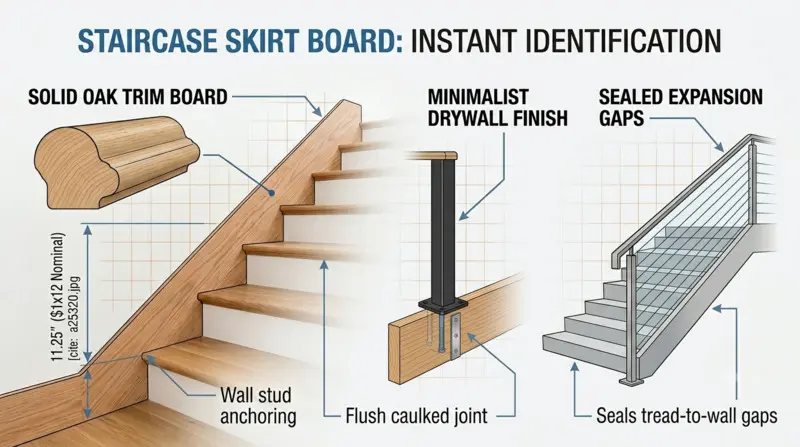
Beyond its visual appeal, a skirting board for a staircase serves a critical structural purpose: it seals the inevitable expansion gaps where treads and risers meet drywall, hides irregular cuts, and acts as a rugged shield against foot traffic, vacuum impacts, and scuff marks, it must seamlessly integrate with your overall safety layout.
- The Main Purpose: A staircase skirt structurally seals gaps between the treads and the drywall while protecting walls from high-impact foot scuffs.
- Standard Sizing: Typically cut from 1 x 2 nominal lumber (actual thickness: 0.75 inches; actual width: 11.25 inches) to ensure adequate vertical coverage above the tread nosing line.
- Core Alternatives: If a traditional solid timber skirt is impractical, builders deploy a stair skirt board alternative such as flexible trim moldings, scribed baseboards, or flush-mounting the drywall directly to the stringer, paired with a heavy bead of structural caulk.
- Material Selection: Hardwoods like Red Oak and Maple offer premium impact defense; paint-grade MDF or clear Pine provide maximum cost-efficiency for carpeted stairs.
Whether you are looking for creative wooden stair railing design ideas, mapping out a new structural build, or retrofitting a skirt board for stairs onto a pre-existing flight, this engineering guide outlines exact layout protocols, material options, and code considerations.
Executing a full staircase overhaul? Match your trim elements with premium, high-load hardware. Browse BuyRailings' professional line of Metal Brackets & Rods and Pre-Cut Metal Tubing to complete your system.
What is a stair skirt board?
A stair skirt board (also known as a stair skirtboard or diagonal baseboard) is a structural finish board installed flat against the wall along the diagonal pitch of a staircase. It sits directly above the treads and risers to conceal the joints where the masonry or timber meets the drywall framing.
Can you build stairs without a skirt board?
Yes, constructing stairs without a skirt board is completely possible, though it demands flawless structural tolerances. Without a skirt board to mask gaps, treads and risers must be cut and scribed with absolute precision directly against the drywall, which is typically finished with high-flex structural caulk to prevent settlement cracking.
Material Metallurgy: Choosing the Right Skirt Substrate
When sourcing wood for stair railing trims and skirtings, your choice of substrate dictates the long-term durability of the staircase hub.
Structural Stair Skirt Board Material Performance Matrix
| Material Type | Structural Density Profile | Best Fit Application | Finishing Options | Longevity Metric |
| Red Oak | High density, excellent grain depth, high impact defense | High-traffic visible staircases paired with stained hardwood treads | Clear coat, oil-based wood stains | Ultra-High (Resists deep dents) |
| Maple | Exceptionally hard, smooth closed-grain fiber structure | Modern, high-end clean line custom architectural stairways | Solid enamel painting, clear lacquer | Ultra-High (Max scratch defense) |
| Poplar | Medium density, smooth uniform grain, highly warp-resistant | Standard residential construction utilizing paint-grade trim | Enamel paint priming (Do not stain) | Moderate (Prone to heavy vacuum impacts) |
| MDF (Medium Density Fiberboard) | Engineered composite, zero knots, completely uniform dimensions | Budget-conscious residential builds or carpeted stairways | Factory-primed, interior latex paint | Low-to-Medium (Prone to moisture swelling) |
If you are matching your new hardwood trim to structural timber steps, it is crucial to pick the right species for long-term structural integrity.
Step-by-Step Installation for Scribing a Skirt to Existing Stairs
Installing a skirt board for stairs during new construction, before treads and risers are locked into place, is simple.
However, retrofitting a board onto an existing staircase requires an advanced trim carpentry technique known as "scribing." Follow this exact sequence of steps to achieve a tight fit.
- Establish the Diagonal Plane: Position the Stock Board.
Take a straight $1\times12$ structural board and lay it across the front edges (nosings) of the existing steps. Push the board flat against the drywall. Use a pair of temporary spacer blocks to lift the board so its top edge sits at least 1.5 to 2 inches above the nosing line. Clamp it firmly in place. - Execute the Scribe Profile: Trace the Contour Exactly. Set a professional profiling divider (or a standard carpenter's compass) to the exact vertical height of your spacer blocks. Keeping the compass perfectly vertical, run the steel point along the profile of the treads and risers while the pencil end traces the identical profile onto your wood stock.
- Execute the Precision Cut: Relief Cuts and Sawing. Unclamp the stock. Use a circular saw for the long, straight tread cuts, then switch to a fine-toothed jigsaw to complete the tight, vertical riser intersections. Relieve the back edge of the cut by 2 degrees (a back-bevel) to ensure the front face makes crisp, seamless contact with the wood stairs.
- Anchor and Seal the Assembly: Dry Fit, Glue, and Fasten. Dry-fit the cut board over the steps. If the joints are tight, apply premium polyurethane construction adhesive to the back of the board. Press it into the wall cavity and anchor it firmly to the underlying wall studs with 2.5-inch (15-gauge) finish nails. Seal any micro-gaps with high-flex painter's caulk.
Structural Alternatives to Traditional Skirting Boards
If retrofitting a thick wooden board involves prohibitive labor costs or tight space constraints, explore these structural stair skirt board alternative design systems:
- Flexible Trim Moldings: Utilizing high-density polyurethane or flexible polymer moldings that follow the exact diagonal pitch of the wall without requiring complex relief sawing.
- Scribed Baseboard Extension: Instead of a single-wide board, standard wall baseboard profiles are mitered at a 45-degree angle to step down along each tread riser, creating a classic paneled trim appearance.
- The Flush Caulked Joint: Achieve a minimalist architectural look by omitting the skirt entirely. The drywall is finished directly up to the edge of the stringer, and a heavy bead of structural elastomeric caulk is applied to accommodate the staircase's natural deflection.
Complete Your Project with BuyRailings
A beautifully finished stair skirt board provides the ideal architectural foundation for a safe, code-compliant handrail assembly.
Once your trim work is locked down, reinforce your space with professional-grade protective barriers from BuyRailings. We supply commercial contractors and residential renovators with precision hardware designed for rapid, weld-free assembly.