 Shopping Cart (




Installing a shower curtain rod seems like a straightforward weekend task, until you are standing in your tub trying to figure out exactly how high to mount the brackets without causing your shower curtain to drag on the floor or let water splash out.
Whether you are figuring out how to install a curved shower curtain rod to add elbow room, mounting a heavy-duty ceiling-mounted shower curtain rod, or trying to secure a temporary tension setup, precision placement is everything.
In this guide, we break down the exact math behind standard shower rod height, walk through different installation methods step by step, and help you select the best fixed shower curtain rod system for your bathroom layout.
The Master Metric: How High to Install a Shower Curtain Rod?
Before opening your toolbox, you must determine your mounting height. Miscalculating this measurement means your shower curtain will either bunch up at the bottom (creating a mold hazard) or hover too high (allowing water to escape).
If you are installing a premium heavy-duty setup rather than a basic spring rod, check out our selection of the best fixed shower curtain rod options built for commercial durability.
Standard Height for a Shower Curtain Rod
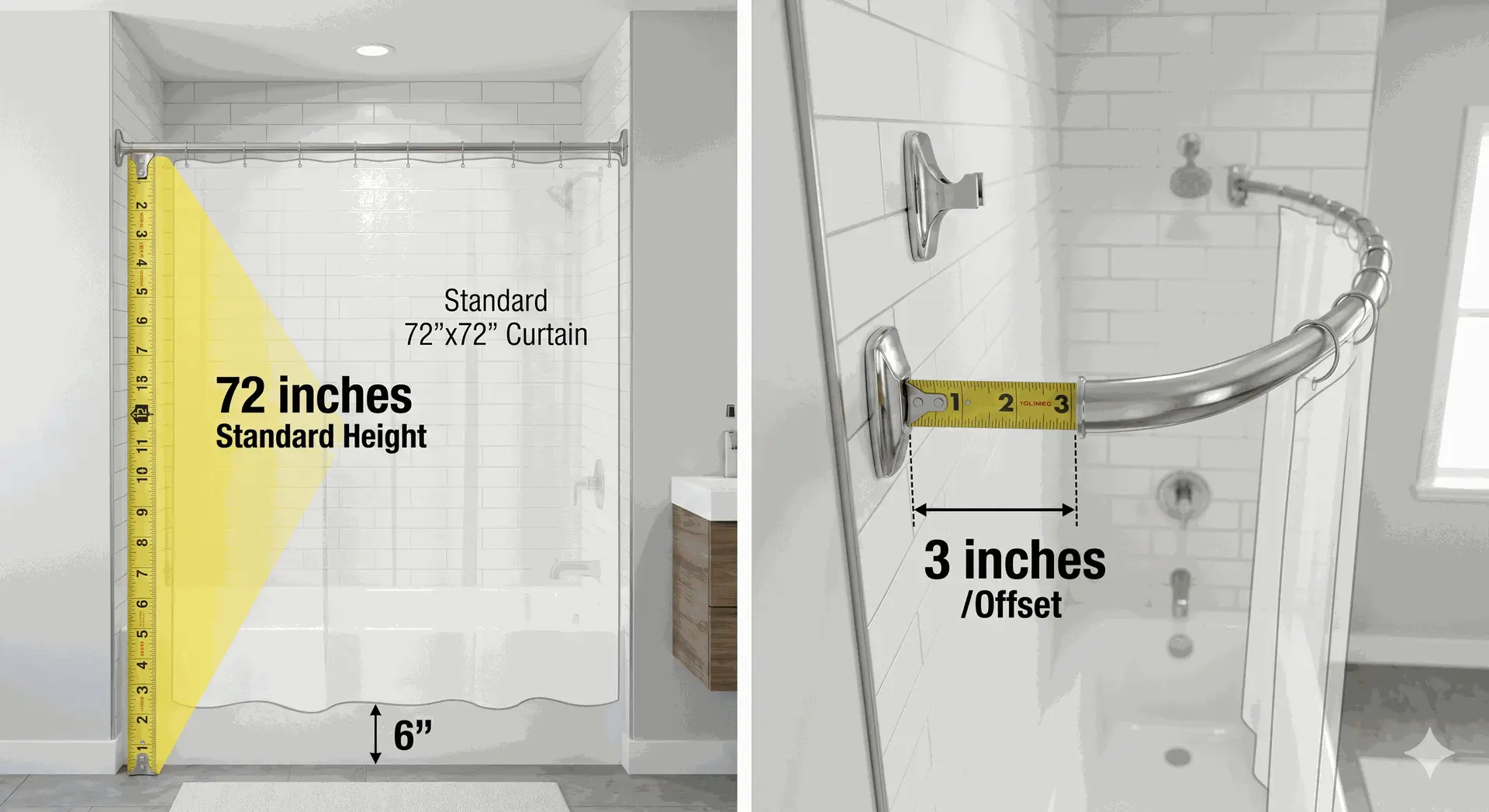
The industry standard is to hang your shower rod exactly 72 inches from the floor.
  [ Ceiling ]
       │
       │  ◄── Mount Rod at 72" From Finished Floor (Standard)
  ================= ◄── SHOWER CURTAIN ROD
       │
       │  ◄── Standard 72" x 72" Curtain Rings & Fabric
       │
  ┌────┴────────┐
  │  TUB RIM    │ ◄── Bottom of Curtain Hangs 6" Below Tub Rim
  └────┬────────┘
       │  ◄── 72" to Finished Floor Line
 ═════════════════ [ Bathroom Floor ]
Why 72 Inches is the Golden Rule:
- Standard Curtain Dimensions: A standard retail shower curtain is $72 \times 72\text{ inches}$.
- The Hook Factor: Adding shower rings or hooks typically appends an extra $1$ to $1.5\text{ inches}$ of downward hang.
- The Perfect Spill Line: Mounting the rod at 72 inches ensures a standard curtain hangs roughly $6\text{ inches}$ past the interior rim of your bathtub, creating a flawless water barrier.
- Note on Extra-Long Curtains: If you have purchased an extra-long luxury curtain ($84$ or $96\text{ inches}$), simply add the height of your specific curtain plus $2\text{ inches}$ for the hooks to calculate your exact floor-to-mount line.
This 72-inch metric aligns directly with hospitality and standard residential bathroom clearance dimensions to optimize accessibility and user comfort.
How to Install Different Types of Shower Curtain Rods
Different bracket styles dictate your bathroom installation strategy. Here is exactly how to manage each type safely.
1. How to Install a Shower Curtain Rod Without Drilling (Tension Rods)
Tension setups rely purely on outward spring pressure against your bathroom walls. This is ideal for renters or those who want to avoid cutting into delicate tile.
- Step 1: Set your curtain rings and fabric onto the rod.
- Step 2: Hold the rod up at your measured shower rod height (72 inches).
- Step 3: Extend the rod out until both end caps firmly touch the opposing walls.
- Step 4: How to Tighten a Shower Curtain Rod: Hold the thick section of the pipe steady with one hand while twisting the narrow section clockwise. Keep rotating until the spring compresses completely and locks firmly against the drywall.
2. How to Install a Shower Curtain Rod with Screws (Fixed & Block Rods)
For a permanent, industrial-grade installation that will never slip, a best fixed shower curtain rod system with wall anchors is required.
For commercial property managers and ADA-compliant accessible hotel stalls, ensure your rod placement adheres to the strict ADA grab bar and shower clearance standards.
- Step 1: Mark your 72-inch height line on both walls using a level.
- Step 2: Place the mounting brackets over your marks and trace the screw holes using a pencil.
- Step 3: If drilling into tile, utilize a diamond-tipped masonry drill bit at low speeds. Never apply heavy brute force, or the ceramic glaze will crack. Insert plastic wall anchors into the pilot holes.
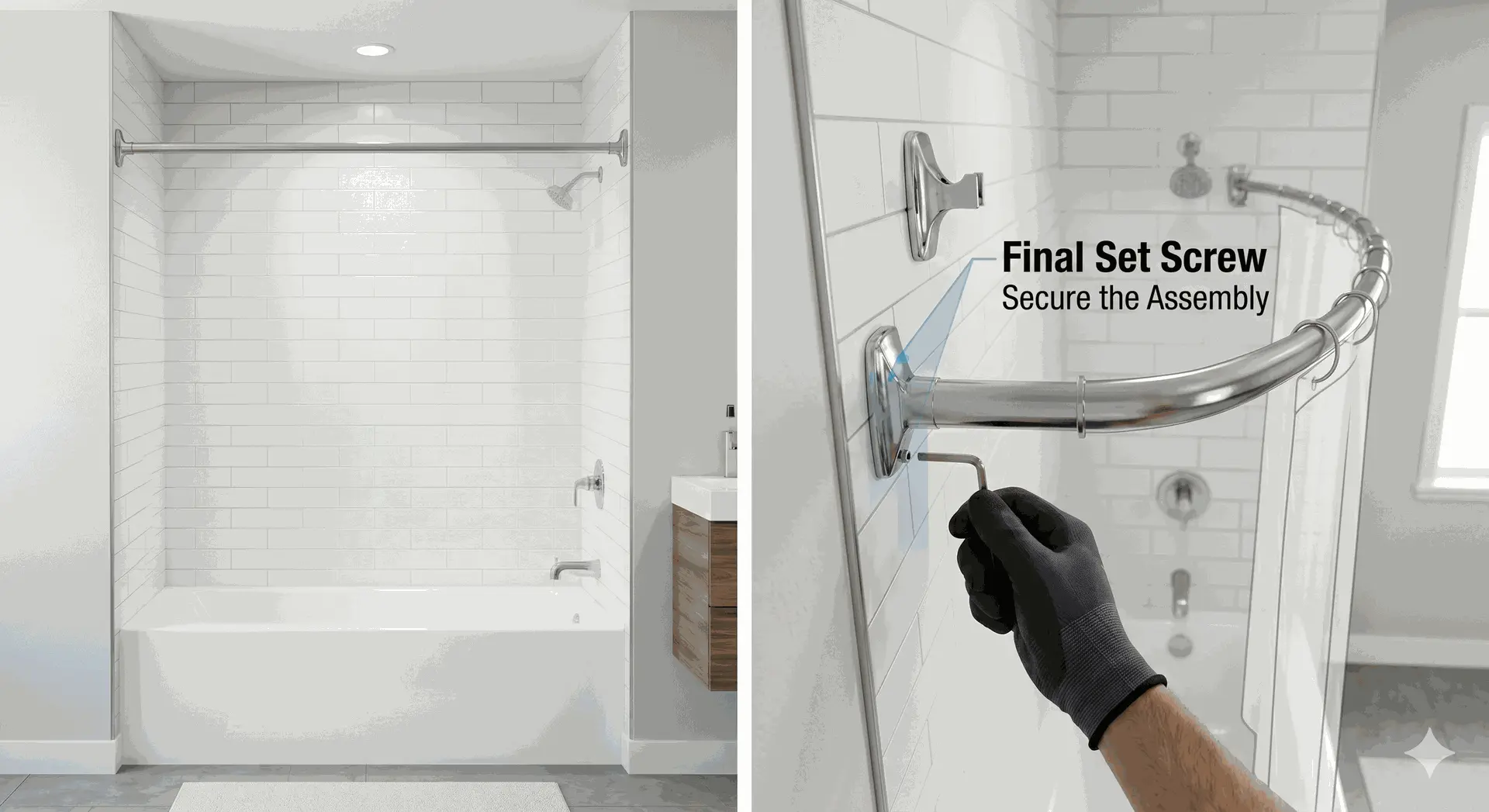
- Step 4: Secure the mounting brackets firmly to the wall using your mounting screws, slide the rod into position, and tighten any integrated set-screws.
For coastal properties or high-humidity environments, choosing a rust proof shower curtain rod made from high-grade stainless steel ensures your hardware never stains your tile.
3. How to Install a Curved Shower Curtain Rod
Curved configurations add up to $33\%$ more space inside the tub, making your shower feel significantly larger. However, the curved shower rod installation height and depth placement require unique adjustment.
- The Offset Rule: Because the rod bows outward, you must mount the wall brackets roughly 3 inches inward from where a traditional straight rod would sit. This ensures the center of the bowed curtain still drapes safely inside the tub basin when closed, preventing external floor flooding.
Shower Curtain Rod Tension vs. Fixed: Which is Best?
| Feature / Metric | Tension Rods | Fixed / Mechanical Rods |
| Drilling Required? | No — 100% Damage-Free | Yes — Requires Wall Anchors |
| Weight Capacity | Low (Prone to slipping under wet towels) | High (Structural, permanent support) |
| Best Material Grade | Standard aluminum/plastic composites | Rust proof shower curtain rod (Stainless Steel) |
| Aesthetic Value | Basic, utilitarian | Premium, architectural, luxury appeal |
To guarantee true corrosion resistance in steam-heavy zones, look for marine-grade alloys tested under ASTM stainless steel specification metrics.
Frequently Asked Questions (FAQ)
What is the standard length of a shower curtain rod?
A standard shower curtain rod is designed to fit an alcove opening of 60 inches (5 feet), which matches the standard length of residential bathtubs.
Most modular or tension rods feature an internal telescoping design that adjusts freely from 48 to 72 inches to accommodate custom architectural alcoves.
How do you stop a fixed shower curtain rod from sagging over time?
If a wall-mounted system begins to sag in the center, it is typically caused by failing wall anchors or heavy downward pressure.
To eliminate sagging entirely, upgrade your setup to a ceiling mounted shower curtain rod system, which utilizes vertical structural support pins anchored directly into a ceiling joist to secure the center pipe line permanently.
To eliminate sagging entirely on long spans or heavy fabric layouts, upgrade your setup to a structural ceiling mounted shower curtain rod system that anchors into a joist.