 Shopping Cart (




When engineering a residential deck or commercial interior stairwell, a continuous vertical flight becomes fatiguing, dangerous, and often code-violating.
Integrating a structural staircase landing and an intermediate horizontal platform breaks up the vertical climb, mitigates fall velocity, and allows the staircase to safely transition directions in an "L-shape" (90 degrees) or "U-shape" (180-degree switchback).
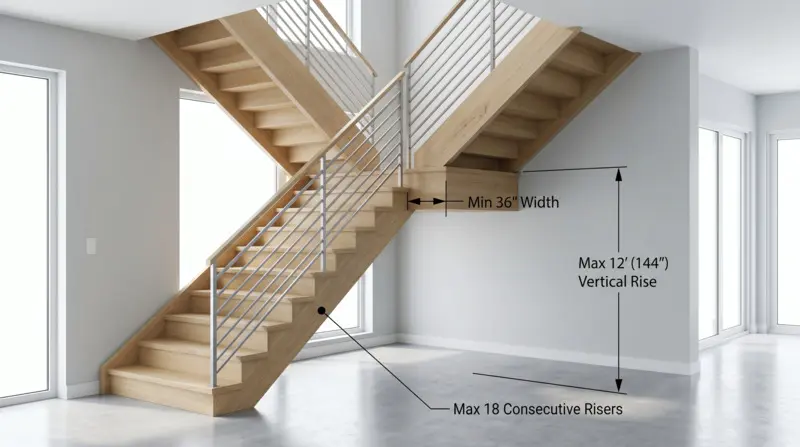
Learning how to build stairs with a landing requires absolute precision across structural carpentry layout, rise-and-run calculations, and strict adherence to localized building inspector mandates.
- Maximum Vertical Rise: Under residential (IRC) and commercial (IBC) codes, a straight stairway run cannot exceed 12 feet (144 inches) of vertical rise between landing platforms.
- How Many Steps Before a Landing? Based on standard residential riser heights (7.75 inches max), a landing is required after a maximum of 18 consecutive steps.
- Minimum Landing Sizing: The length and width of the platform must be at least equal to the actual width of the stairway channel: minimum 36 inches for residential code paths and 44 inches for commercial code paths.
- Structural Framing Rule: Headroom clearance must be at least 6 feet (80 inches) vertically from every point on the landing floor to the ceiling above.
Framing a commercial or residential stairwell? Ensure your infrastructure passes inspection. Browse BuyRailings' heavy-duty Handrail Brackets and code-compliant Industrial Pipes to complete your assembly safely.
Sizing & Structural Building Codes: IRC, IBC, ADA, OSHA
To safely pass a structural inspection, your stair landing framing must strictly comply with the precise specifications dictated by your project's governing code.
Dimensional Comparison Matrix
| Governing Code Standard | Minimum Landing Dimension (Direction of Travel) | Max Vertical Rise Between Platforms | Structural Mandates & Slip Resistance |
| Residential (IRC) | 36 inches x 36 inches minimum | 144 inches (12 feet) | Must support a 30-psf live load; slope must not exceed 1:48 for drainage. |
| Commercial (IBC) | Matches stair width (44 inches minimum) | 144 inches (12 feet) | Continuous handrails required on both sides through the landing run. |
| Accessibility (ADA) | 60 inches x 60 inches (For turns) | 60 inches (5 feet) max per run | Required at the top/bottom of all accessible ramps; max 2% level slope. |
| Industrial (OSHA) | 30 inches x 22 inches minimum | 144 inches (9.5 feet) | Must feature a durable, non-slip texture; guardrails mandatory if open >30". |
Continuous handrails are required across the landing plane if the stairs turn. Review our guide on when a handrail is required for stairs to map your transitions.
Math Blueprint: Calculating Stair Steps with a Landing
To calculate stair steps with a landing, treat the setup as two independent staircases joined by a flat floor. Let's calculate a real-world scenario: a 120-inch total vertical rise with a midpoint landing.
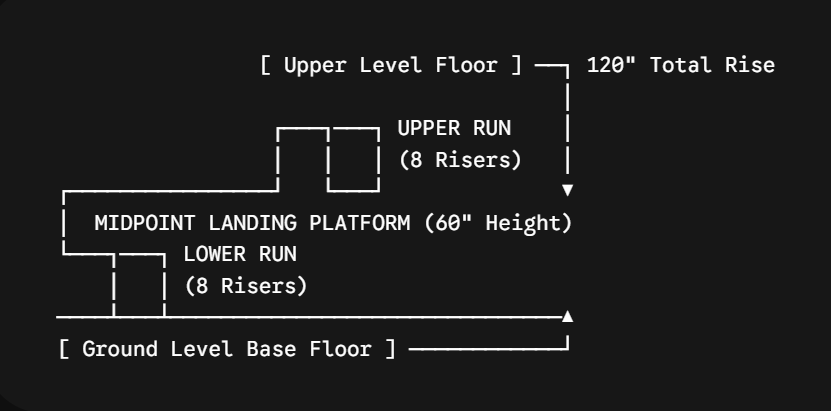
The 5-Step Framing Calculation Matrix
- Divide Total Rise: Split the total 120-inch rise exactly in half to place the platform frame at a stable 60-inch midpoint.
- Determine Ideal Riser Height: Divide your target lower-run height (60 inches) by thlower-run height (60 inches) by the standard, comfortable unit riser height of 7.5 inches.
- Establish Total Step Count: 60" / 7.5" = 8 Risers for the lower staircase flight. Repeat for the upper run, yielding 16 total risers across the entire structural installation.
- Calculate Total Horizontal Run: Subtract 1 from your riser count to find your tread count (8 - 1 = 7 treads). Multiply 7 treads by a standard 10.5-inch unit tread depth to find your horizontal footprint: 73.5 inches from the floor base to the front of the landing frame.
- Verify Platform Dimensions: Ensure the landing frame provides at least an additional 36 inches of travel clearance before the upper flight starts framing upward.
Once your rise and run dimensions match your platform height, ensure your underlying wall trim handles the angle. Read our tutorial on cutting a skirting board for a staircase to seal the drywall edge.
How many steps are allowed before a landing is required?
Under the International Residential Code (IRC), a stairway is permitted to have a maximum of 18 continuous steps (risers) before a landing platform is legally required. However, the definitive trigger is height-based rather than step-based: a landing must be integrated anytime a staircase reaches 12 feet (144 inches) of continuous vertical rise without a break.
Step-by-Step Construction: Framing and Anchoring a Landing
Follow this structural carpentry sequence to frame a durable deck stair landing or an internal wood stair tower:
Build and Square the Platform Frame: Assemble Outer Rim Joists.
Construct the box frame of the landing platform using pressure-treated 2 x 10 or 2 x 12 structural lumber. Drive 3-inch framing screws through the corners and measure diagonally from corner to corner to ensure the ledger box is perfectly square.
2. Anchor the Support Posts: Set Structural Post Columns.
For exterior deck stair landings, support the platform frame using heavy-duty 4 x 4 or 6 x 6 structural timber posts anchored to solid concrete footings. Secure the posts to the rim joists using structural wood ties or through-bolts.
3. Attach the Lower Stair Stringers: Install Structural Joist Hangers.
Position your lower stair stringers flat against the face of the landing rim joist. To ensure the joints never sag under lateral weight loads, secure them using specialized metal slant-seat stringer hangers screwed tightly into both the framing timber and the stringer throat.
4. Anchor Upper Stringers and Apply Subfloor: Notch and Lock the Upper Run.
Set the upper stair stringers so their top notches rest completely flush over the rear framing plate of your landing platform.
Bolt them down securely with structural ledger screws, then install thick plywood or premium composite decking across the landing floowith structural ledger screws, then install thick plywood or premium composite decking across the landing floor.
Complete Your Project with BuyRailings
Building a safe staircase with an integrated landing is only half the project. To meet building safety codes, your intermediate platform and structural runs must be reinforced with code-compliant handrails and secure path guardrails.
At BuyRailings, we supply commercial developers and residential trim carpenters with heavy-duty, weld-free component hardware.